Sound Atlas Series: Central Victoria, Robert Curgenven with Tara Gilbee


RF003
RF003
Sound Atlas Series:
Central Victoria
Robert Curgenven with Tara Gilbee

Detailed, dream-like photographs and field recordings realised in conjunction with the Test Match project at Allans Walk Artist Run Initiative in Bendigo (Central Victoria), 14-20 November 2007. A beautifully produced collection of photographs and field recording compositions presenting an audiovisual survey of the area in and surround Castlemaine to the growing regional centre of Bendigo, combining an intimate local knowledge with an extensive understanding of the Australian landscape. Re-approaching the concept of the Sound Atlas developed in RF001, Gilbee and Curgenven uncover the regions’ socioeconomic and geo-historical dimensions – from the site of the world biggest alluvial goldrush in the 1850s to a landscape radically transformed: to ghost towns; by the ravages of prospecting, industrial developments; and the new tide of “settlers” fleeing the big cities.

http://www.recordedfields.net/label/releases_rf003.asp

Blindside Exhibition 2007


Video work exhibited by Tara Gilbee and Andrew Goodman related to the collaborative project, Deluge. The small video and sound pieces were part of a series of works which explored concepts about the transformative nature of and metaphors associated with water. In their recent work both artists have explored the experience of the human body.


Drawing upon the writings of Deleuze and Bataille that advocate the immersion of the body in physical sensation, these projects explored the concept of ‘affect’, the direct physical connection between the viewer’s body and the ‘event’ that works to blur boundaries between the two. The work references science fiction, anime and Japanese horror films which frequently exploit an Animist view of the world. In this small work the viewer’s engagement with the work was intimate and voyeuristic.

for further information
http://www.blindside.org.au/2008/the-big-smoke.shtml

mise en abyme 2007

TARA GILBEE
Mise en Abyme

Gilbee’s oeuvre entails a complex exploration of human existence that often borders on the ineffable.  The ethereal and somewhat ephemeral nature of her materials complements this sensibility while enhancing an intrinsic poeticism in her work.  While this exhibition continues her investigation of ‘interior’ worlds - on both physical and psychological levels – the work shifts towards an exploration of the relationship(s) that exist between consciousness and the creative impulse through emotions such as fear, anguish and desire.

Using photography (light) as her principal medium, Gilbee has constructed mysterious and elusive collages in both still and video formats.  Comprised of abstract and fragmented human (mostly male) forms - including eyes - Gilbee transforms popular imagery found in magazines into a preferred aesthetic derived from her unconscious and/or the shifting, shadowy forms of dreams and imagination.  Reminiscent of surrealist photography and cinema, these evocative forms also act as symbols of erotic desire which the surrealists saw as providing the stimulus for revelation and creativity.

What is interesting, however, is Gilbee’s further use of light to ‘ephemeralise’ the above formats and intensify the dreamlike quality of her chosen imagery.  For example, a light placed underneath the stills - mounted on semi-opaque Perspex - casts residual phantom-like forms onto the walls.  On the other hand, the video is projected into a three-dimensional, translucent black Perspex structure that reflects, diffracts and diffuses the imagery through layered, angular surfaces so it forms a continuously changing shape that mutates and transforms in a rhythmic pattern determined by a breathy, whispering voice that repeatedly utters the words, “his eyes, his eyes, his eyes…”

As the allegory of Plato’s cave would have us believe, these shadow- or dream-like forms demonstrate that the foundation of reality can never be reached and we can only ever observe and/or know things in their ideal forms.  Another protagonist of this idea was Lacan, who often stated that “the real is impossible”.  But for both, this is because we are caught up in a symbolic order of language ie. reality cannot be expressed in language because the very entrance into language marks our irrevocable separation from the real…

By asserting that the unconscious is also structured like a language[1], Lacan suggests that our lack of any relation to reality is what gives rise to our fantasies and leaves us in a constant state of desire.  If we return to Gilbee’s work and her exploration of consciousness, her use of the idealised man is as a symbol of fantasy and desire.  But in recognising this and completely transforming the ideal into an abstracted, dream-like form it also becomes a symbol of her own creativity.

As the title Mise en Abyme suggests, the imagery in the primary photographic and video formats represent an emblematic structure that belongs to a larger narrative, which is represented in the projections.  The ensuing phantom-like forms and infinitely transforming images within the black Perspex structure are like a dream-within-a-dream and symbolise our lack of reality through the intertextual nature of language.  But it also symbolises the artists’ studio - an unending journey into the unconscious, releasing fantasy, desire and creativity.

© Kirsten Rann, Melbourne July 2007


[1] Lacan, Jacques, The Four Fundamentals of Psychoanalysis (The Seminar of Jacques Lacan, Book 11), 1998, p. 203.

exhibition ' 3X3 = 6 degrees of separation' in Darwin @DVAA

Further images for this show will be posted in time, however I thought it would be good to add this link from a work that Jacques Soddell did for the show.

Titled 'Spaces' 2007 : Jacques derived sounds from the spaces betweens words in earlier interviews he had recorded for Punctum's production of 'Shed' in 2005.

http://vimeo.com/64701204


Chinese Whispers


Castlemaine State Festival : 2007

Installation in New China Restaurant,Castlmaine. Collaboration between Tara Gilbee and Andrew Goodman.

This art work was composed of digital stills on transperant film, light boxes, paper leaves and surround sound. The work emulated an asian pagoda and worked with the idea of rumour mills and secretative conversations, furtive sound bites in small towns.

Utilising inspiration from the decor and site the work created a small installation which was a new custom within the restaurant for two weeks. The audience to this work where a broad range of people, from the elderly who had a regular table at the front of the restaurant, to children who ran around the work exclaiming "its alive in there".


Breathing down your neck


Installation for Mma : Clubs, Melbourne 2004

Video documentation of a live art action, whereby the audience where invited to breath on a perspex plate with a person on the other side. The work had mirror plates on the wall behind and the audience where reflected within the action.

The work was the final in the Velvet light series which explored the dynamic of the breath and experiencing the breath in a reflective manner.

The work was concieved months prior to the SARS outbreak but was actioned around this time, when the notion of a stranger breathing on you could cause fatal harm, this added another element to the reading at the time.

velvet light series III


Digital images on perspex and mirror 2004: Images 80 x80cm mirror dimensions variable.

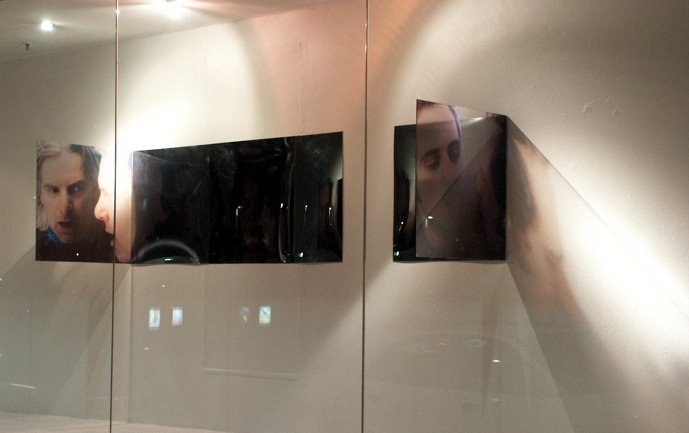
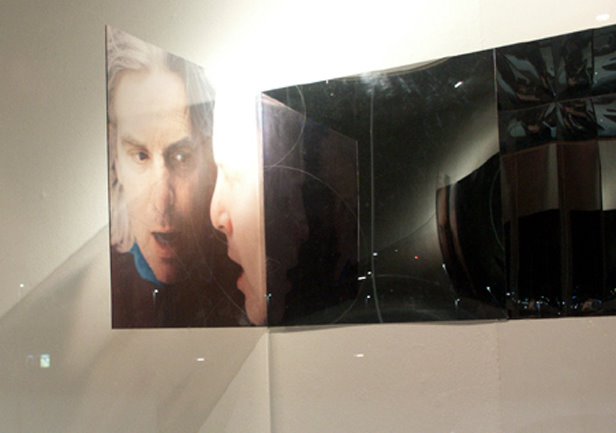
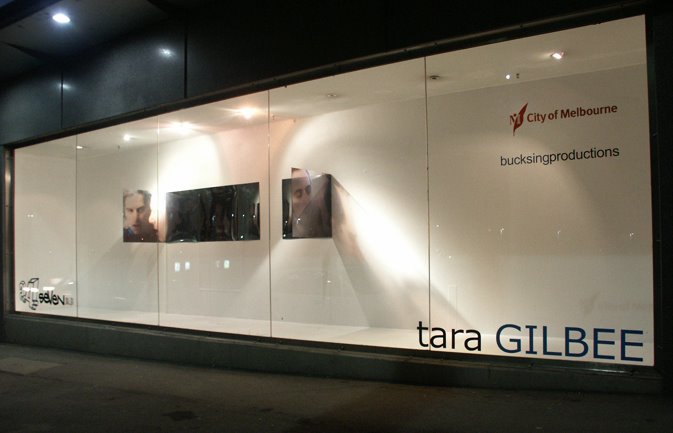
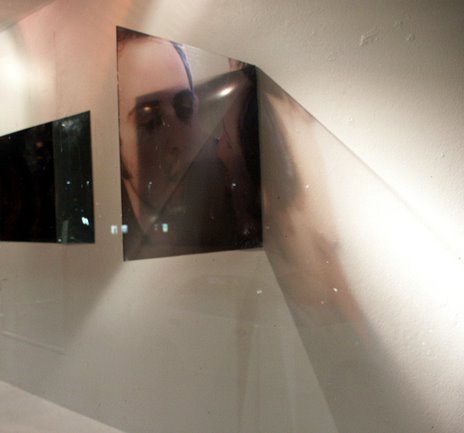
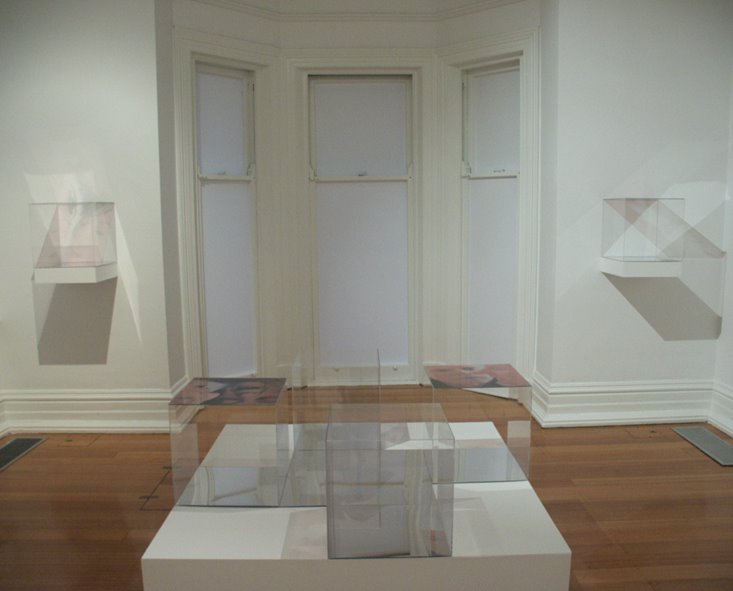
This is the largest and most complex in the velvet light series. It has been difficult to represent in documentation, as the manner in which it interacts with the surrounding space and its own image, making it illusive. A door was removed from the back of the window space (10mt wide +3mt high) and covered to allow only the 80 cm hole in which a mirror box inverted into the next space behind the wall. Then mirror ran vertically along the wall to meet the two large images that were sitting at right angles from the wall.

As people walked past the installation they became part of it, as did the passing transport and weather patterns of the day. The image shimmered and interacted within the box where the female image was placed and outside where the two males where. The triptych then darkened and flattened at night, the internal box receded and from a distance looked like a flat dark surface. The external images became faded under the brighter lights but projected large shadows of themselves on to the walls, spreading across the space.

velvet light series II


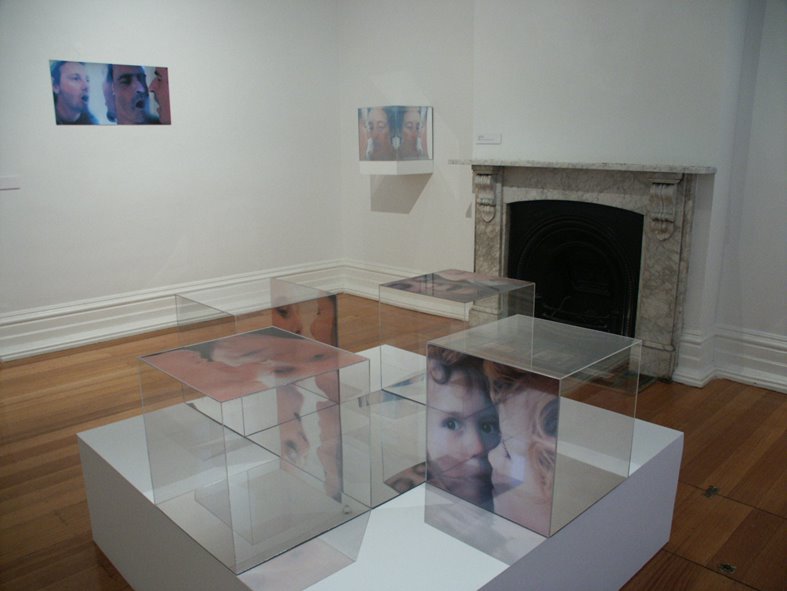
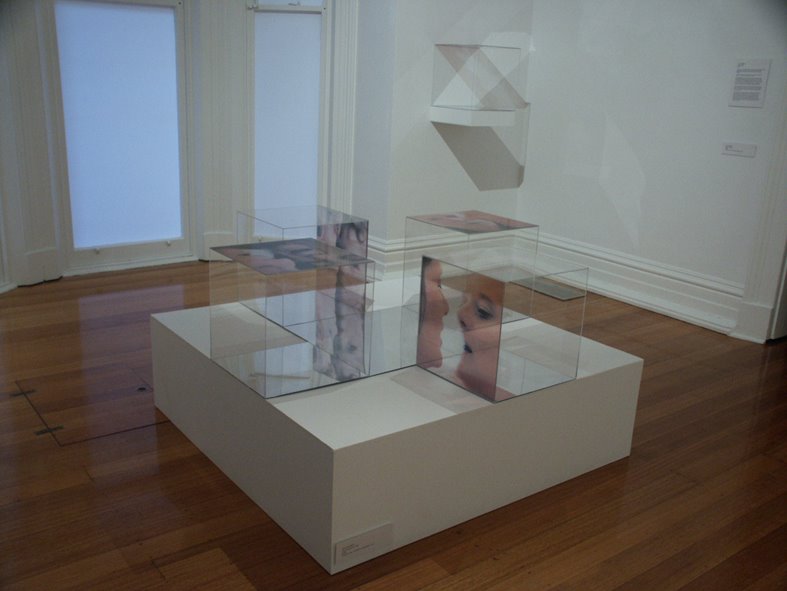
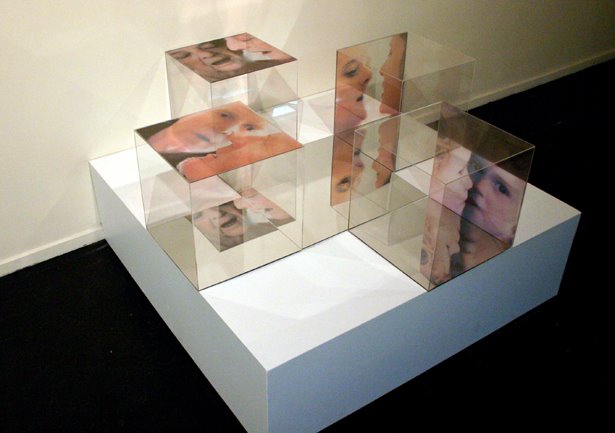
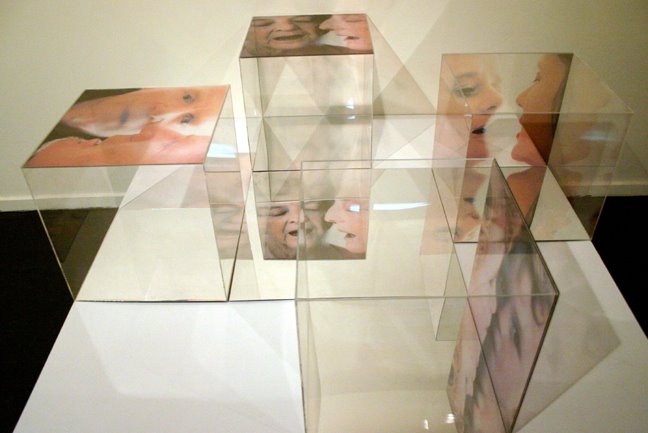
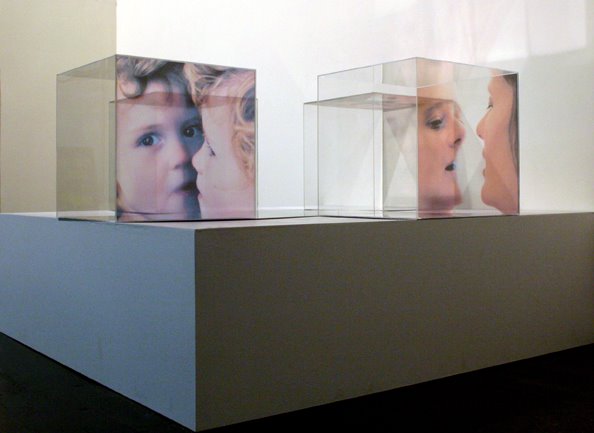
Digital images (clear) on perspex with mirror bases 2004: dimensions variable each cube 40cm.

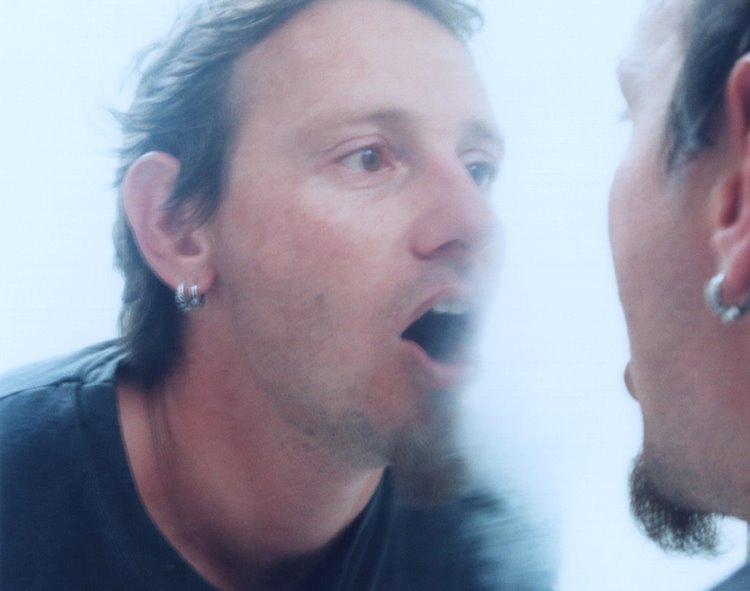
There is a powerful tool in the third person, which is created by observing someone observing him or herself. A disquieting sense of voyeurism about a persons private introspection.

In these installations sharp reflections make it appear the sharp reflections make it appear as if the mirrored subjects are breathing themselves into life. It is a restrained distance that is imparted, a strong sense of viewing from behind a wall at an intimate moment. As the audience get closer they too become part of the subject and then sense their own part within the world of others and the space between.

velvet light series I


Digital prints on clear perspex or mirror 2004: 40cm x 40cm.

In this work I aimed to dissolve audience inhibition by gently and subtly calling them towards reflections and refraction of light so they became enmenshed within the network of reflected and projected imagery. The images on the clear perspex projected onto the walls like slides, at first it appears hard to discern where the image is coming from as the horizontal plane of the clear perspex image is hidden from the eye and only the shadow play on the wall is evident. Then when investigating the clear boxes, the mirror at the base absorbs the image and projects it downward and within the supporting base, to appear like a hole.

As the audience explores the work they also find themselves within it. The photographs work as a complimentary engagement with the other materials. The mirror makes illusion and reality interchangeable, creating uncanny spaces in which to observe the image. The photographs are clearer in the mirror than they are as a surface to observe. The projected content is easier to explore, while trying to observe detail on the actual image becomes very difficult, it shimmers and changes, interacts with the surrounds and the observer.

velvet light series


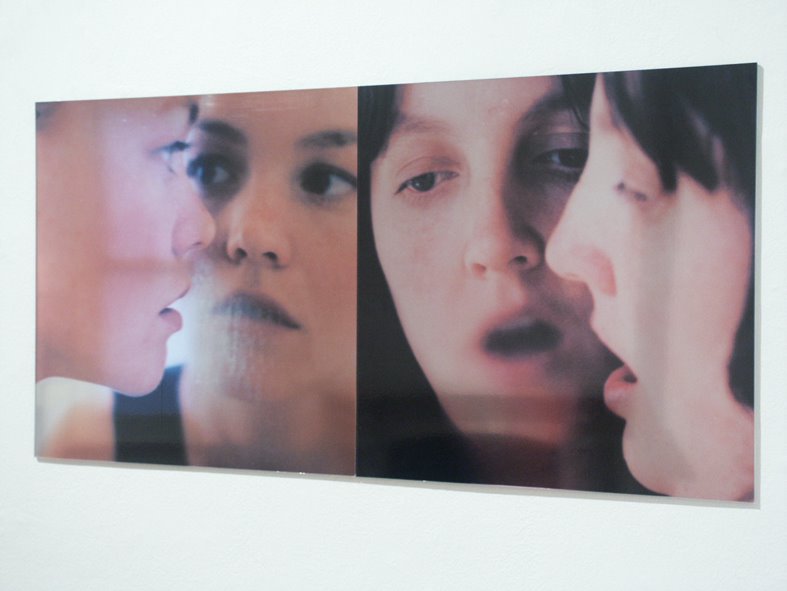
Digital prints 52 x 66 cm and digital prints on clear perspex or mirror 40cm x 40cm 2002 –2004:

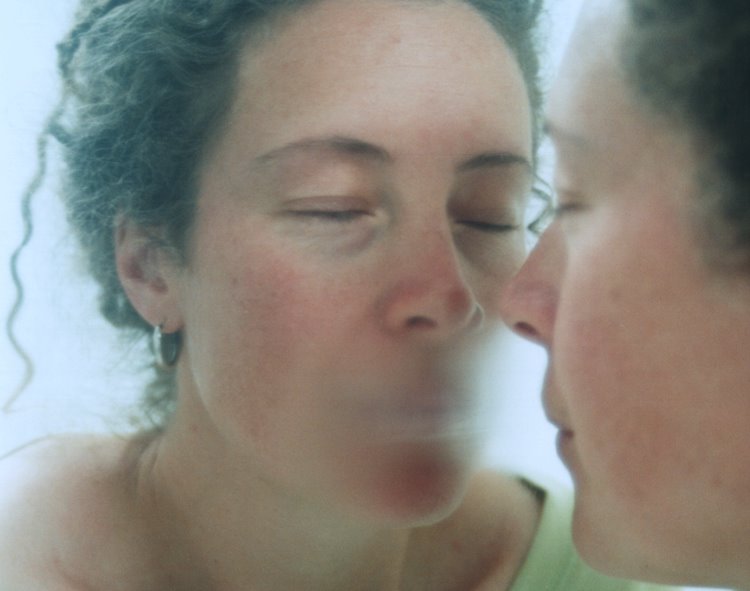
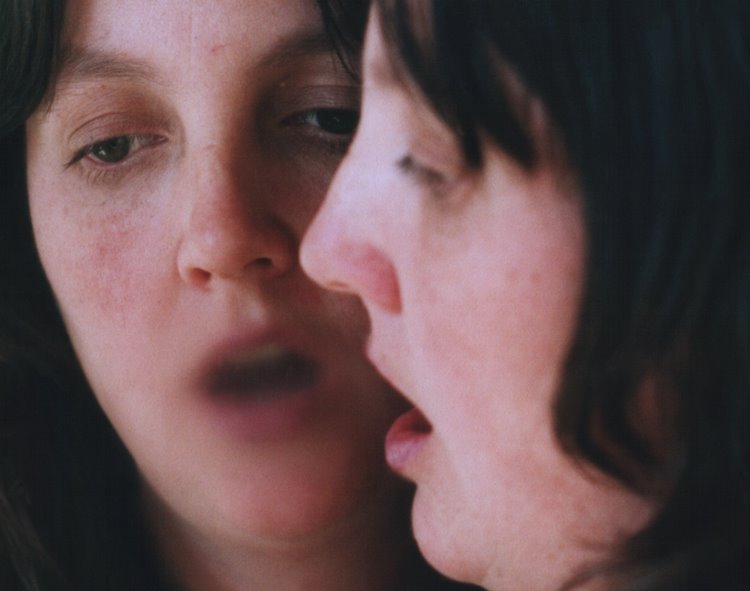
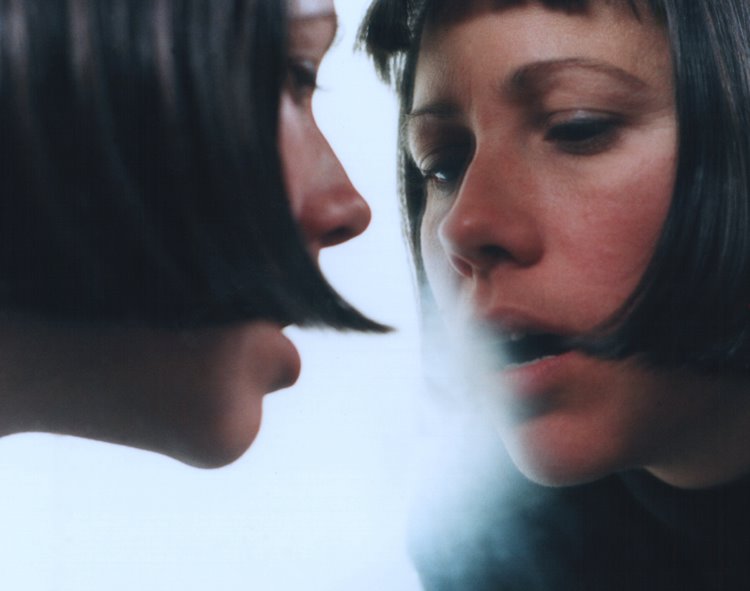
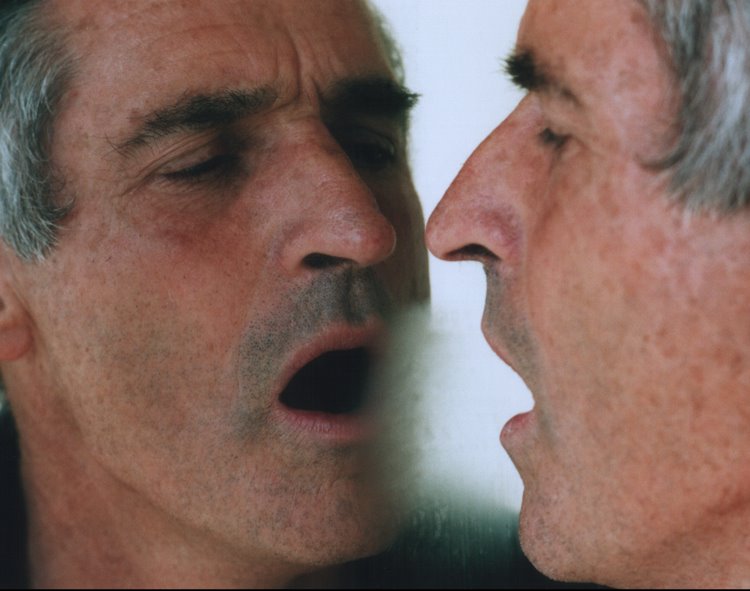
‘velvet light’ is a series of images and exhibitions which explored the breath and interstitial space , using a combination of photography and sculpture. The series was based around sculptural installations that utilised photography, mirror and translucent materials. It is an ongoing body of work that builds on itself through the reapplication of concepts and materials in new contexts.

The photographic material is derived from situations that portray intimate/interior moments where there is a sense of transitional boundaries. The images refer to the mysterious spaces between the body and its external environment and the relationship a person may have with their reflection. The image shows the person as fragments of reference, their profile says one thing about them, their reflection another. The myriad of surfaces and angles with which we can be observed is at play within the portraits. On first observation the one person appears as two and the moment reads in a more intimate/ sexual way. It is also confounding how there is a reverberating dialogue between the same person, we attempt to read a conversation from one image to the other but it is not available, as it is a singular conversant thought only available to the sitter.