The elaboratory and the elixir of life: an alchemical wonderment.


This is a installation project in development, a work that explores both the materia medica of the sites garden and a poetic examination of the exoteric and esoteric aspects of Alchemy. 

Summary of Alchemy

Alchemy was introduced into Europe at the time of the Crusades. The first alchemical texts were translated from Arabic into Latin. 
Alchemy was a mysterious and terrifying art to those unfamiliar with it. Alchemists used odd-shaped instruments and magical incantations, codified symbols and symbolic colours. Science was considered a challenge to the authority of the Church, as were many things not understood by everyone. Aristotle's books were banned. 

Crave wisdom of God, the sense to understand,
Else meddle not herewith, nor take it in hand.
For it will cost thee much worldly wealth;
But trust not to other, but do it thyself.
Learn, therefore, first to cleanse, purify and sublime,
To dissolve, congeal, distill and sometime
To conjoin and separate, and how to do all,
That when you think to rise, thou do not fall,
Trust to thyself and not to another;
I can say no more to thee if thou were my brother.

- Simon Forman, 1597


Tutes Cottage


Tutes Cottage and Garden is a rare artefact of the Victorian gold rush. Established c.1854, the property is an important reminder of the Victorian Government's strategy after the Eureka Rebellion to provide land to its new settlers through the granting miner's residential areas.
From 1855, a Miner's Right entitled the holder of a mining claim to also occupy a parcel of land as a Residence Area, for the purpose of a house and garden. The land on which Tute's Cottage stands was continuously held under a Miner's Right until 1996: only then did it revert to Crown possession. It appears that, because the cottage's various occupants could never aspire to own the land, they were little inclined to make 'improvements' to the structure. As a result, its original architectural style has survived with remarkable clarity and integrity.


The work


An installation that explores transmutation with a laboratory of mystery and wonderment.

This series of works builds on research in France 2011 and personal themes relating to the body. The alchemist's work was based on Aristotle's theory of earth, air, fire, and water : These four elements were related to the four humors: phlegm, blood, bile, and black bile. In a healthy human, the humors were balanced; illness resulted from imbalance of the humours. Alchemy was not entirely just a search for the stone that would turn lead into gold. Many alchemists used that search as a metaphor for the search for moral perfection, believing that what could be accomplished in nature could be accomplished in the heart and mind. 


This new work will be presented at the Castlemaine State Festival, within the theme of the festival 'Elemental'. Utilising a unique and historic venue within the goldfields, the concept of transmutation within Alchemy will be explored as a sensorial and evocative experience. Drawing parallels with the search for the elixir of life the work aims to draw the audience into a sensorial exploration. The audience will be lead through a few rooms which will be set up in various states. There will be glasses filled with aromatic liquid, reflections projected through various lighting techniques, as well as rooms with an abundance (which appears overgrown) of dried herbs, lit and silohetted within.

This work continues a relationship to previous works Deluge and Cold Light exploring various transformations of material that eluded to watery under world states, with mysterious forces at hand. 


You Must Remember This


Catalogue Essay by Kent Wilson 2011
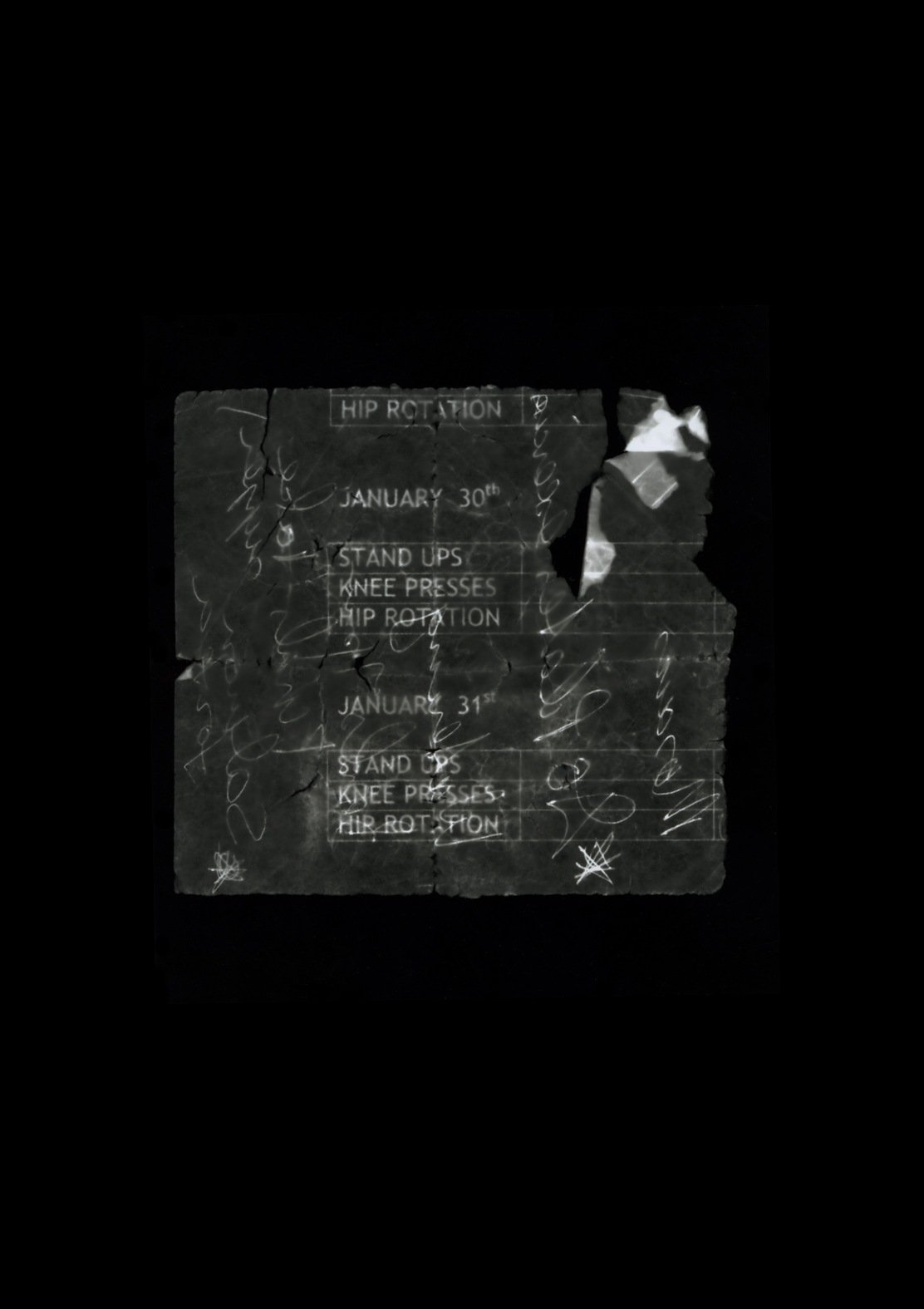
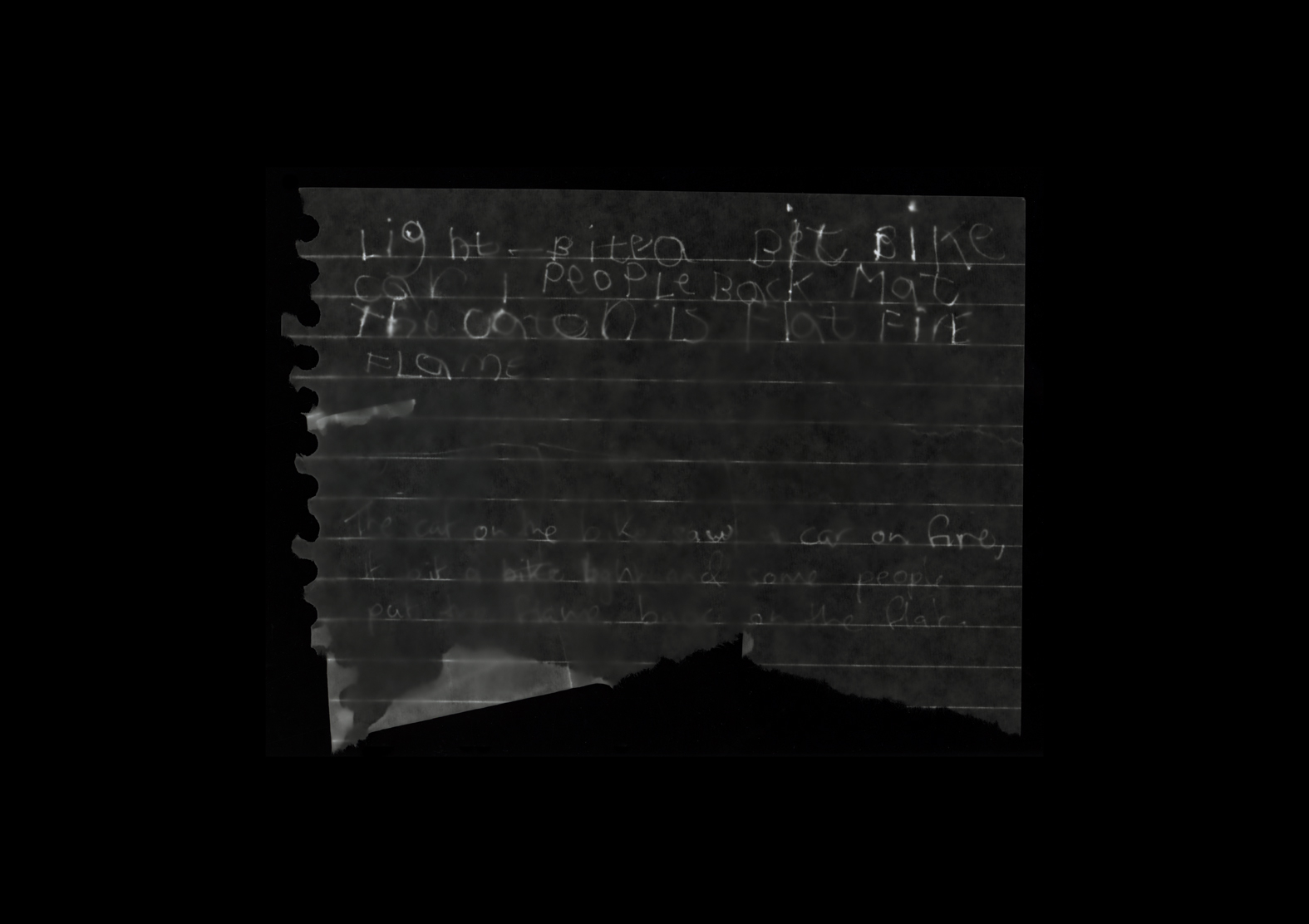
Inscribed by time, marked by history and floating in a blackened void of implied vastness, Tara Gilbee sets before us a collection of gathered artefacts. And not unlike icons cast up on the walls for us to decipher in an exchange of give and take, these images are conduits of transfer. They provide us with hints of their utility, with fragments of text, words and scribbles that imply a proscriptive intent – they are guides. But they don’t give us enough. They are like a rosetta stone or a broken code to be translated through a process of gap filling. Who wrote these, why did they write them, and where are these people now? Only the invocation of the vast void within which they now flounder can offer recourse, if any, as we project our own histories into the well.


This is forensic grappling. The documented nature of the original artefacts, photograms of lists and notes collected by the artist over time, give the images a sense of focused inspection. Light has been poured over scraps of paper, reacting with the film below, and leaving an indelible imprint of the materiality of the original. These are shadowed reflections. A once important task, a fleeting significance, now monumentalised here as a granite asteroid.


The rich blacks, deep and heavy, envelope the space and create a still and silent ambience. Not unlike a library or secret archival storehouse, the works hush the space. The granite and marble textures of the captured notes read like tombstones and reinforce a sense of reverence. Floating and drifting like weathered leaves or planetary palimpsests. Fleeting and ethereal paper, fragile and transitory, chiselled into solidity and structure.

Time spent in the space is rewarded with a fluctuating and oscillating sense of slippage. The works walk a tense tightrope between figuration and abstraction, between minimalism and complexity, and between dynamism and stasis. As soon as you grasp one aspect, the other creeps in to take over - only to slip back away again. What at first appears to be a set of black and grey abstract patterns, not unlike Rothko paintings stripped of colour and materiality, and rendered in flattened photographic prints, suddenly emerge as clearly documentary images of actual things. But just as quickly as that transition is made, they slip back into abstraction, and the mind grapples with other interpretations of the forms.  The flatness gives way to depth thanks to the unfocused sections of the photograms generated by the folds in the original notes. The scribbles flip between random markings and legible text.  All this within an invocation of the universal sublime.

I hope you enjoy this series of works as much as I do, and that you find your own rambling meanings amongst the beautiful imagery.

Kent Wilson 2011


Thanks: goes to Stockroom and Colour Factory: The staff's professional handling of the artworks and production was impeccable! As well as my friends Kathryn McCool, Tony Cameron and Robyn Walton for their continued support. Also to Punctum Inc and their funding supporters for the opportunity to attend Inhabit International in France; as well Regional Arts Victoria for supporting my professional development through their quick response grants.

http://www.stockroomkyneton.com/

http://www.punctum.com.au


noirlac


Please review the page titled Noirlac Research Residency for ongoing updates and information about the project. 

I am not a regular blogger, so the updates will be sporadic,  however I am interested if you would like to add comment or if you also have inspiration to share! 

The project is open for comment and input and I would love other artistic responses.

Please see the link to the Abbaye for some background, it is in French, I can fill you in on some details if you have specific questions.

http://www.abbayedenoirlac.fr/

France via Hongkong and lots of waiting

I have made my way to France for the beginning of the Inhabit Residency. The journey was long with a 5hr stop over in Hongkong so I am just beginning to land in this time zone.


I will post a few pictures taken on route to the France in this post.


I will create a separate page for my project at Abbaye Noirlac see tabs on home page.

The weekend I arrived a fantastic artist group ZUR where presenting their research for a performance in May 2012

http://www.groupe-zur.com/

The work was presented in most of the buildings of the Abbaye and the work was an encounter with the poetics of the space, it enchanted audiences with kinetic sound and light pieces that entranced and enlivened curiosity.

What a wonderful way to venture within the Abbaye and begin the residency ..... now what can I do...

In-Habit International residency September

Stay tuned for more information regarding my upcoming residency at  Abbaye  Noirlac in France September
2011

Abbaye Noirlac

Brief explanation of Punctum's In-Habit International program


Punctum, in Castlemaine, Victoria, Australia, manages an international arts research and cultural exchange program – In-Habit International.

Each year through this program Victorian artists working across contemporary art forms that incorporate cultural exchange are awarded a grant to live and work with a host arts organisation in an overseas country.

Four exchanges are offered per year.

What is In-Habit International?

The aim of our arts research and cultural exchange program is for either

• Regionally based Victorian artists to have access to new and stimulating international environments.

• For metropolitan based Victorian artists to have access to new and stimulating regional environments internationally.

We support artists who seek to learn about their host country and its artistic practices and to contribute to the cultural life in the local community of the Host Organisation. Our hope is that these exchanges will result in ongoing relationships between regions, artists and cultural organisations in Victoria and globally.

The cultural exchanges are professional development opportunities celebrating regional arts practice for Victorian arts practitioners and also act to foster reciprocal relationships between artists and arts organisations.


In-Habit International focuses on arts practice that engages with the site, place and arts orientation of a particular Host Organisation and its surrounding community. Cross art form practices and those that embrace the fabric of everyday life and straddle the boundaries of art, science and technology, social activism, design and architecture and live art are also eligible.

http://www.punctum.com.au/inhabit

Cold Light : Exhibition


Dates: 15 September to 24 October 2010

Opening September 16th: 6-8pm
to be opened by Martin Paten
Director of Castlemaine State Festival.

Venue: Latrobe Visual Arts Centre
121 View St , Bendigo, VIC
Contact: Paul Northam
Tel: +61 3 5441 8724
Email: vacentre@latrobe.edu.au
Web:http://www.latrobe.edu.au/vacentre

'Shadows are a corset for light. When forms emerge unknown they dance on our field of perception, igniting imaginary landscapes and projections of desire.' Tara Gilbee

'Cold Light' is a series of photographic images that utilise the refractive qualities of light, manipulated through lens and mirrors, to distort and transform the materials at hand.

The shadowy imprints explore a psychological landscape. Traversing the beauty of dark looming shapes while seeping into watery fields of the unconscious. Dream like visual fields mesmerize and draw the viewer into a liminal field of possibilities.


opening images:


Link to collaborative work with Lauren Berkowitz

http://www.videoartchive.org.au/lberkowitz/endoscope.html


The Australian Video Art Archive (AVAA) was established in 2006. Its aims are to:

•continue building an on-line video archive and a research collection of new and historical Australian video and performance art works,
•to allow researchers to borrow the material for educational, research and exhibition purposes, and
•to transfer old video or film artworks to a digital format to conserve the work and thus assist in the conservation of a significant genre of Australian art history.
Currently, the collection contains some seminal works by prominent Australian artists. This collection will continue to expand and we are accepting submissions to consider for inclusion.

The archive is the first program of its kind in Australia and has been established with generous assistance from the Faculty of Art & Design, Monash University with the involvement of Prof. Anne Marsh, Matthew Perkins and Elena Galimberti.

New Exhibition at Saxony


This exhibition displays a set of large A1 images, from my new series Cold Light.

It will be launched Monday 12th July and run for 6 weeks.

At the New Saxony store in World Square Sydney

The art and the fashion intersect with the season’s inspiration.
Spring Summer 2010’s theme is:

“In spite of its function as a reservoir for human darkness or
perhaps because of this- the shadow is the seat of creativity.” Carl Jung

Review in Realtime

This link (click on title of post) takes you to a great article on the Inhabit Project 2010 that i was part of:

It starts as

......"In-habit was an exceptional, inventively curated month-long series of 11 performance, live art and installation works situated in and around the Abbottsford convent. Involving nine key artists, more than a dozen associate artists and numerous participants, these artworks emerged out of a collective residency at the convent established by artistic director Jude Anderson exploring site/place/space and cultural exchange".......

Barry Laing is a Melbourne-based performance maker and writer who teaches at Victoria University and Monash University. He is an Associate Editor of Theatre, Dance and Performance Training Journal, Routledge, UK.

RealTime issue #96 April-May 2010 pg. 33